Two pieces of furniture in one
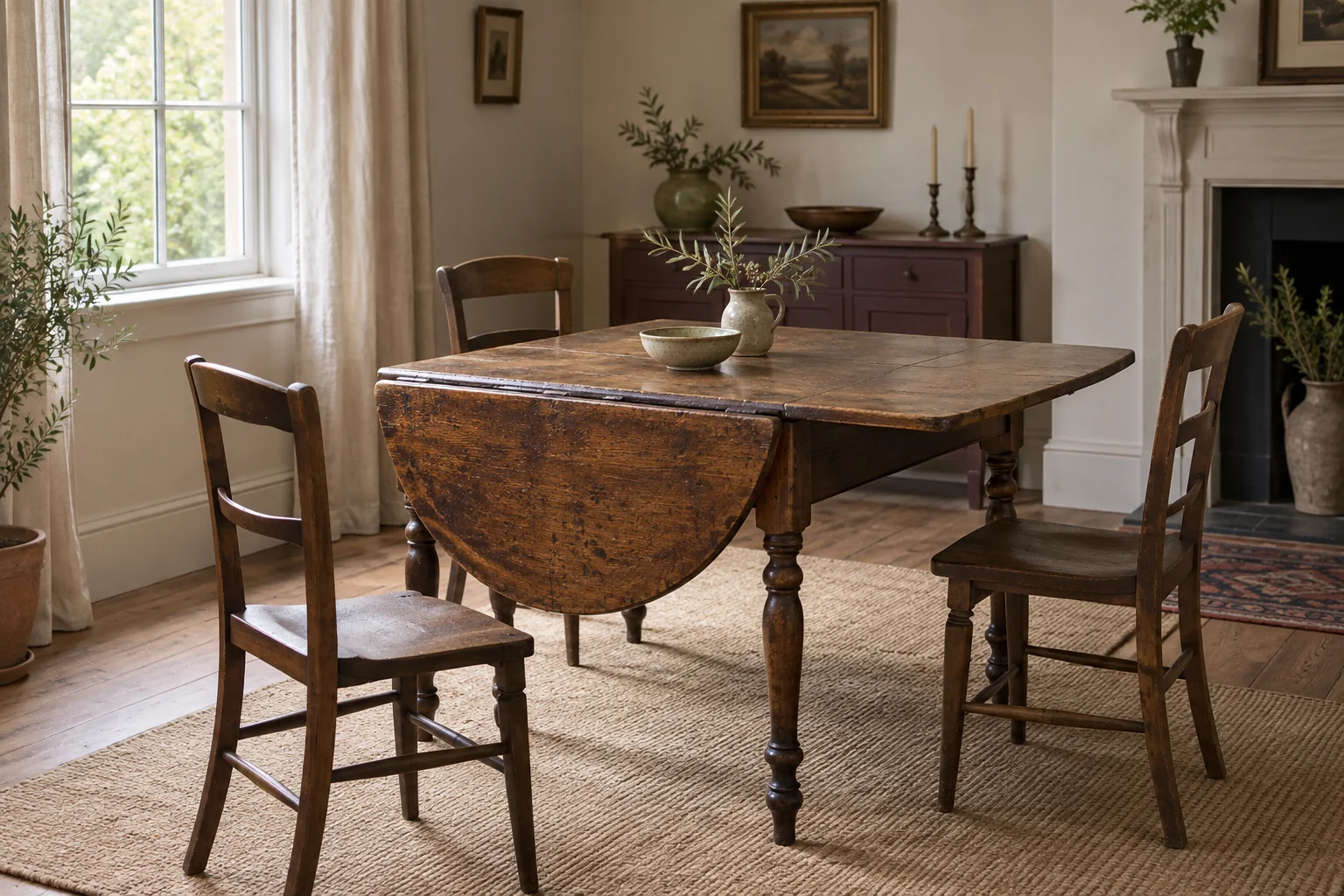
A drop-leaf table has to succeed in two different states. Folded, it may serve as a narrow surface against a wall. Opened, it has to accommodate dinner without turning the room into an obstacle course. It is easy to fall for the small footprint in a listing and forget that the larger version still needs chairs, legs and a route to the kitchen.
Draw both outlines on a room plan. Then mark the positions of the people who will actually sit there. A table used open every evening should be comfortable in that form; the folded dimensions are secondary. If you expect to open it only for visitors, decide where the extra chairs will live between meals. Flexible furniture is most useful when its companion pieces have a plan too.
Look beneath the leaves
The support arrangement matters as much as the top. Gate legs can create several possible seating positions but may also compete with knees. Other tables use sliding supports beneath the leaves. Ask the seller to demonstrate the mechanism and show it fully engaged. Do not assume that a leaf which remains horizontal in a photograph is adequately supported for normal use.
Inspect hinges, attachment points and the edges where the leaves meet the central section. A visible gap may affect the way plates and glasses sit even when the table feels sound. Structural doubts call for professional advice. Avoid buying on the theory that one screw or a discreet block of wood will solve a problem whose extent you have not established.
Request a view from the short end, where supports are easiest to judge. It can reveal a cramped seating position that a flattering overhead photograph completely misses.
Make opening it an ordinary action
Some adaptable furniture is inconvenient enough that nobody bothers adapting it. Ask whether you can operate the table comfortably and whether the procedure requires moving several other objects first. A lamp, vase and stack of books on the central panel might look lovely, but they need somewhere to go when dinner appears.
Consider the floor surface as well. Moving a table back and forth across a thick rug can make a supposedly simple routine cumbersome. The room may work better with the table left partly open, or positioned so only one leaf is used most days. That arrangement should be evaluated in its own right rather than treated as a compromise you will somehow stop noticing.
Rehearse a meal for two, then one for four
Try thinking through two ordinary arrangements rather than a single maximum capacity. With one leaf raised, two people might sit comfortably on adjoining sides while the other half remains near the wall. That could be ideal for breakfast but awkward if the legs leave only one usable corner. A plan drawn from above will not reveal every problem beneath the tabletop.
Next imagine four people eating. Where does each chair go when someone stands up? Which person has to move to let another pass? Where will a serving dish wait if the tabletop is occupied? You may discover that the room can accommodate four perfectly well if a nearby surface holds the extra dishes, but poorly if everything must stay on the table.
Keep the rehearsal grounded in your own habits. A table that opens a few times a year can reasonably ask for some rearrangement. One opened every evening should not require moving a heavy chair and finding temporary homes for several fragile objects. If the daily version is easy and the occasional version is workable, the table's flexibility has a real purpose.
Let its changing shape guide the styling
A modest pendant or nearby wall light can suit both table sizes more easily than an elaborate display centred on the fully extended version. Likewise, artwork above the folded table should still make sense when the furniture moves away from the wall. Think in terms of the whole corner rather than decorating one carefully chosen photograph.
Before committing, ask for measurements with both leaves down, one raised and both raised. Those three numbers describe three different ways of living with the piece. An honest appraisal may reveal that a fixed small table would suit you better. Or it may confirm that the drop-leaf design offers exactly what the room lacks: enough space for supper, followed by an easy return to a room that feels open.