Look past the sparkle
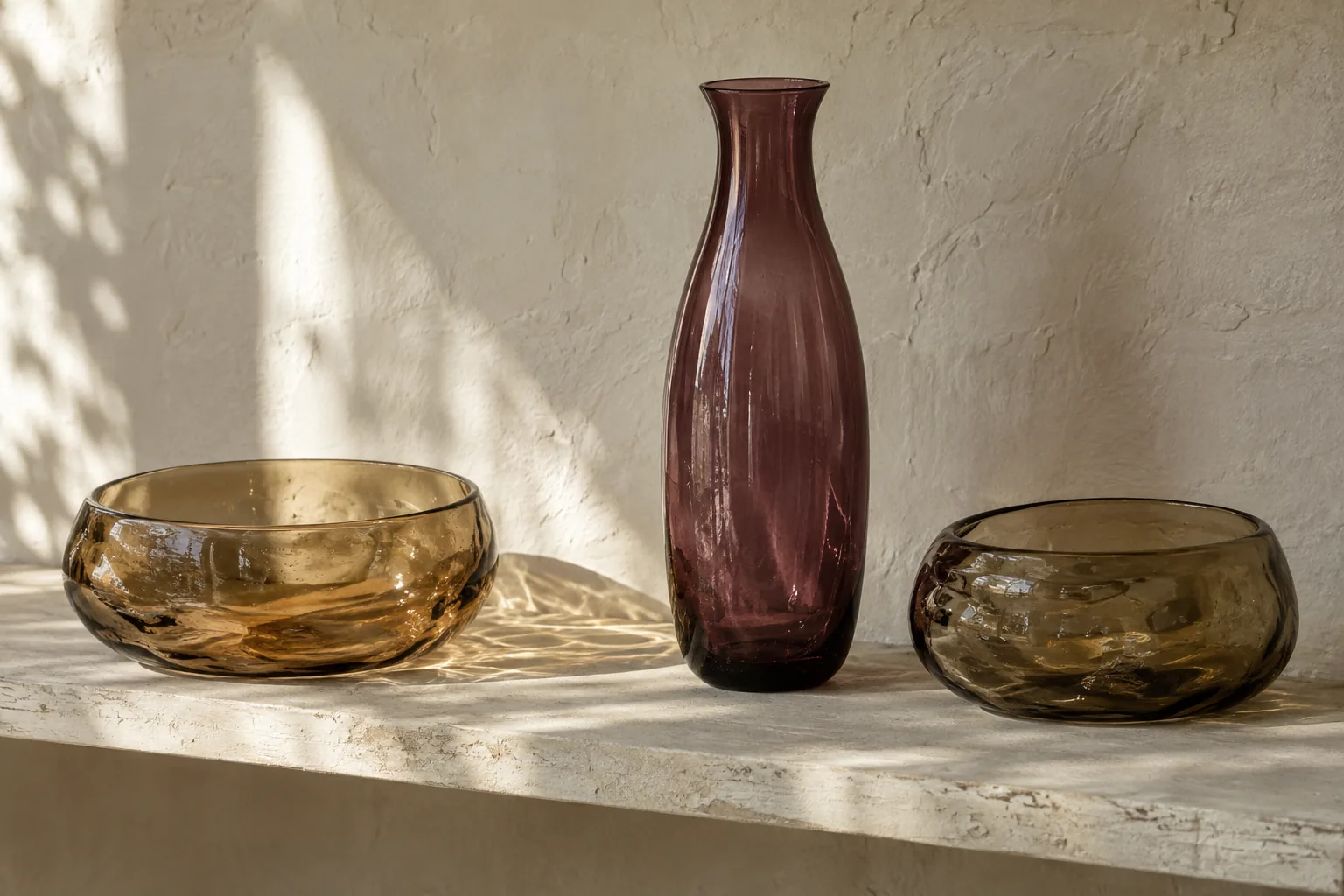
Glass can be persuasive under a shop's lights. Reflections make an ordinary bowl look complicated, while a beautiful outline disappears against everything behind it. If you are choosing primarily for your home, begin with the silhouette. Look at the piece against a plain background, with the seller's permission, and consider how it would read from across a room.
A bottle with a long neck makes a different contribution from a wide, low bowl. The bottle draws the eye upwards; the bowl holds a horizontal surface. Neither is inherently more useful. Think about the space you have: a narrow mantel, an open bookcase or a table already occupied by a large lamp.
Measure the widest point
Online measurements often give height and little else. Ask for the maximum width, including handles or projecting rims, and the base diameter. A vase can fit a shelf by height while extending uncomfortably beyond its depth. A dramatically flared bowl needs more breathing room than its foot suggests.
At home, cut a piece of scrap paper to the object's footprint and place it where you imagine the glass will go. This simple test reveals whether you are buying a display piece or a daily obstacle. Include the space needed to lift it safely. A snug fit between two books is seldom a comfortable permanent home.
Check the outline close up
Inspect the rim, foot and any applied handle before becoming absorbed in decoration. Ask for clear close photographs if shopping remotely. Chips may be hard to distinguish from bright reflections, and a single photograph cannot show the whole edge. Do not run a finger around a potentially sharp rim to find them.
A slight irregularity is not, by itself, proof of age or hand production. Nor does a heavy base identify a maker. Enjoy those characteristics as visual qualities unless you have reliable supporting information. A seller who can distinguish observation from attribution gives you a more useful description than one who supplies a confident story for every bubble.
Test the shape in a group
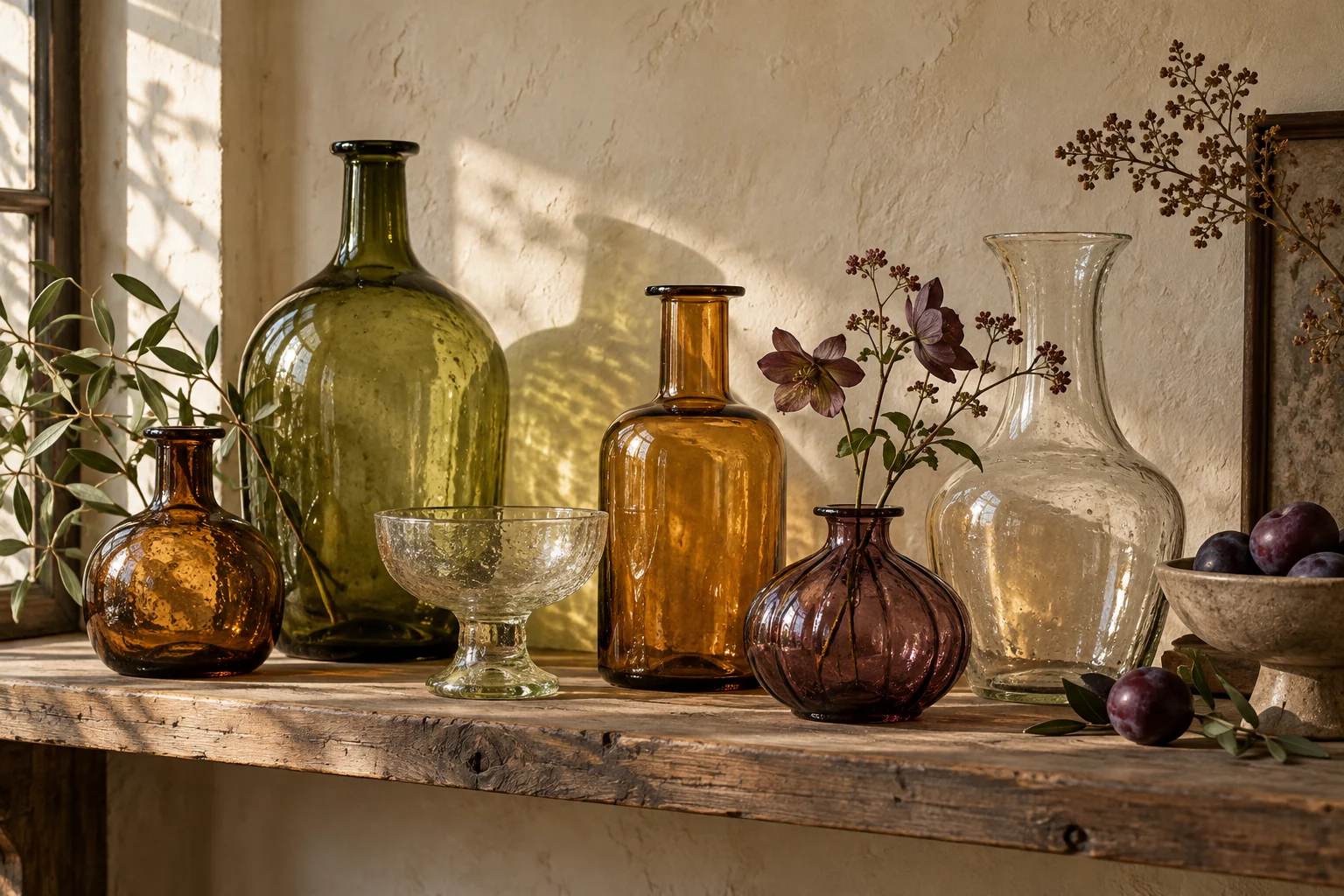
If you already own several glass pieces, compare outlines rather than shopping for another exact colour match. A cylindrical vase might bring order to a group of rounded forms. A shallow dish can give a tall bottle something to relate to. Too many narrow necks at equal intervals may look repetitive even when the colours are different.
One clear object can be enough amongst coloured glass. It leaves a pause without adding an opaque block. Turn the group slightly and look from your usual seat as well as straight on. Overlapping shapes sometimes look elegant from the front but become a muddle from the side.
Be honest about the intended use
A decorative bottle does not have to hold anything. Choosing an empty display role can be perfectly sensible when its history, condition or suitability for liquids is uncertain. Do not buy a narrow-necked vessel assuming that any residue inside will be easy to remove. Ask about cloudiness and repairs before purchase rather than treating cleaning as a guaranteed transformation.
The V&A's glass-care guidance is a useful starting point when assessing care needs. Keep the purchase decision separate from a restoration project: choose the object as it stands. If its shape still pleases you without promised sparkle, flowers or an impressive attribution, you have a stronger reason to bring it home.