The handle makes a persuasive promise
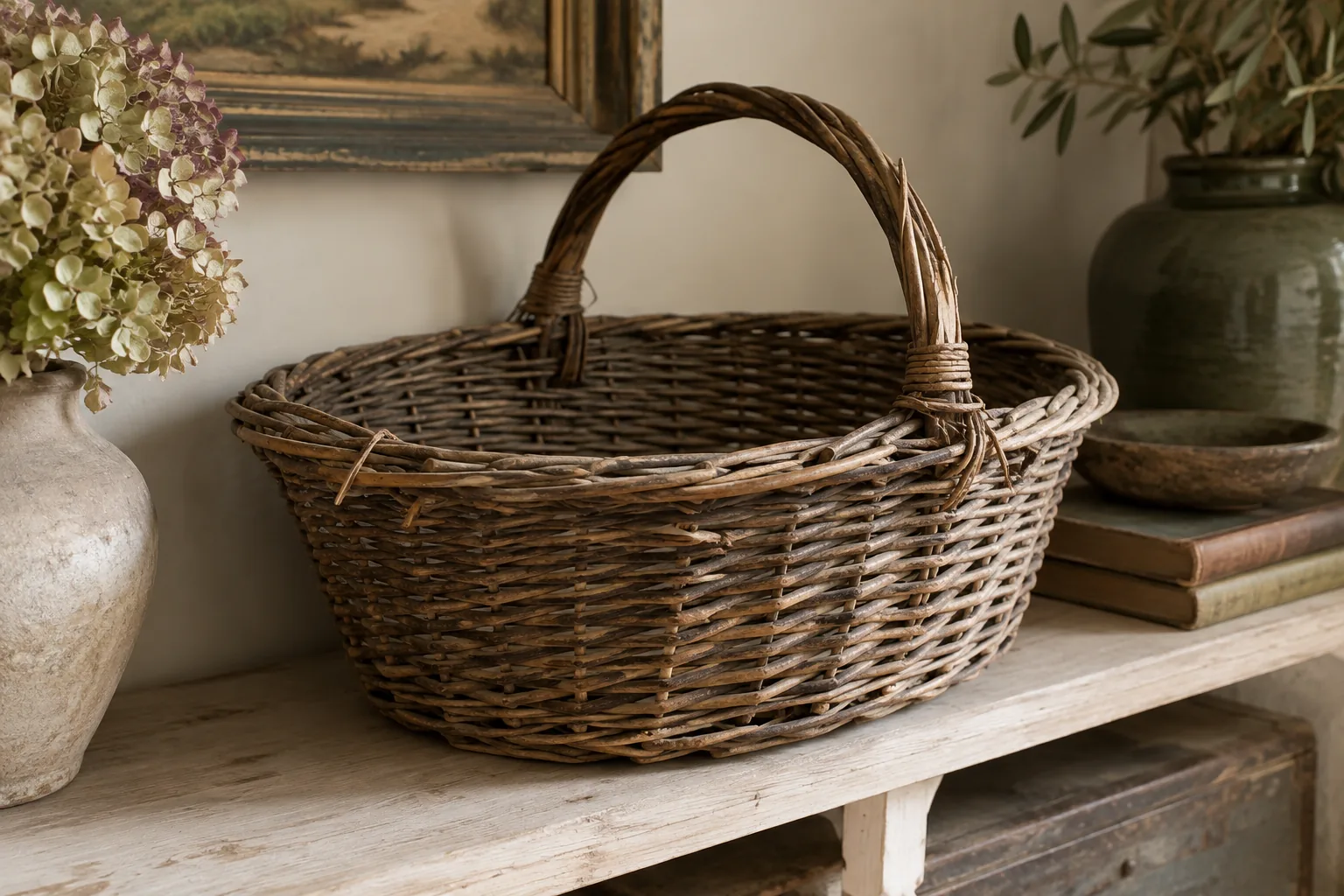
A basket with a substantial handle seems to explain its own use. Pick it up, fill it and carry it somewhere. With an old basket, the handle's appearance is not proof of its present strength. Before assigning a useful job, look at the connections, base and areas of wear, and ask what is known about its condition.
An attractive basket can still contribute to a room without carrying laundry or logs. It might remain a display object or hold only items appropriate to an assessed condition. Choosing a lighter role is not a failure to use vintage things properly. It is a way to keep enjoying a particular object as it exists now.
Notice the material without guessing too much
Woven objects can be made from different plant materials and may include coatings, dyes or mixed components. The Canadian Conservation Institute's basketry guidance explains that these distinctions affect care. A general label such as wicker does not provide enough information to justify one universal cleaning or conditioning method.
Photograph the weave, rim, base and handle connections. Look for broken elements, distortion and areas that differ noticeably from the rest. Do not pull at an end to see whether it is loose. If identification or stability matters to the intended use, send those observations to a suitable conservator.
Keep routine care modest
Avoid soaking, oiling or applying household mixtures because the basket appears dry. Such treatment should not be chosen from appearance alone. Ask for advice suited to the materials and condition, particularly where there is decoration, a fragile surface or an important family history.
Think about the surrounding routine as well. A basket beside a hearth may collect debris; one in a bathroom may encounter moisture; one beneath a table may be kicked. Changing the location or purpose can reduce the need for repeated cleaning. Care can begin by choosing a less demanding job rather than by finding a stronger treatment.
If a piece sheds fragments, stop using it and preserve the detached material with a clear reference to the object. Do not weave loose ends back into place experimentally. A small intervention can alter the structure or conceal information that a specialist would find useful.
Make storage and display easy to handle
Choose a stable surface that supports the basket appropriately. Avoid squeezing it into a shelf opening that presses on the rim or stacking other objects inside without considering their weight and contact. A basket that fits perfectly only when compressed is in the wrong space.
Do not rely on the handle for movement if its strength is uncertain. Obtain guidance on supporting the body, particularly for large or fragile examples. Prepare the destination before lifting so that you are not holding the object while deciding where it should go.
Labels belong in the inventory or on appropriate separate packaging, not stuck casually to the weave. Record any known maker, place, date or family association while the information is available. Distinguish a documented history from a decorative description supplied by a seller.
Allow age to remain visible
An old basket may have an uneven colour, a slightly irregular outline or evidence of use. Decide which features you enjoy and which require assessment. Do not call every new break character, but do not assume a uniform colour is the necessary end point of care.
A simple arrangement often shows the workmanship best: one basket beside a quieter surface, with enough light to see the pattern and enough space to understand its shape. If the object no longer suits heavy use, its construction can still be the reason to keep it. The most thoughtful role is one that respects its present condition while letting you notice the skill in every crossing strand.