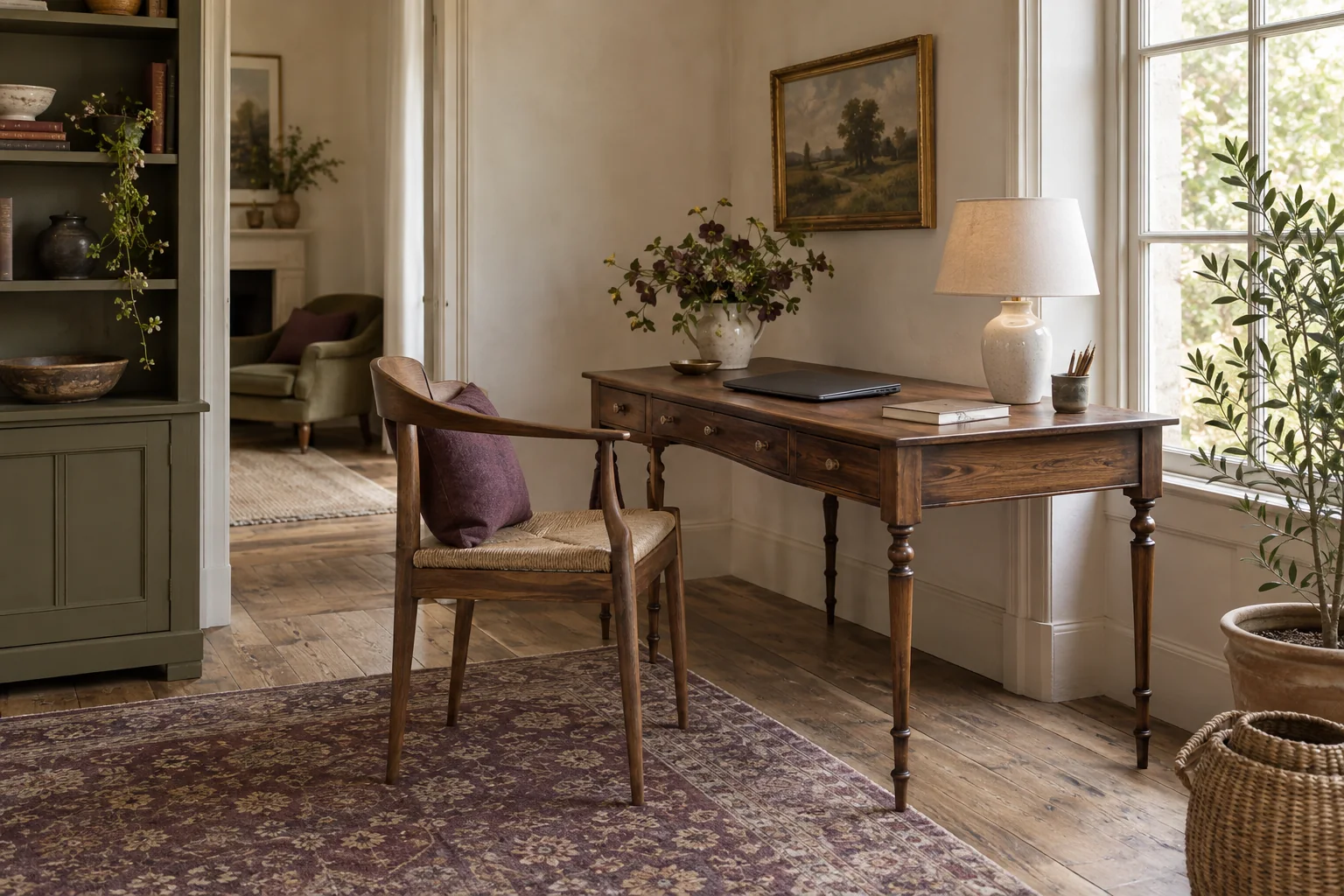
Begin with your actual equipment
A notebook and a fountain pen make almost any desk look workable. A screen, keyboard, lamp and charging lead are less forgiving. Before browsing, set out the equipment you use during a normal day and measure the area it occupies. Include the space needed to move a mouse and open a book without balancing either on the edge.
Depth is particularly easy to underestimate. A shallow writing desk can be lovely for correspondence but cramped for a computer setup. If you use a separate screen, check that its stand leaves a comfortable working area in front. A monitor arm should not be assumed suitable for an old desktop; its clamp and concentrated load need to be compatible with the construction.
Include any documents that must remain open beside the keyboard. Paper tends to expose a shortage of working space sooner than neatly arranged electronic equipment does.
The opening matters more than the width
A broad desk can have a surprisingly narrow kneehole. Measure the opening between pedestals and the clearance beneath any central drawer. Compare both with the chair you intend to use, including its arms. You need to move in and out without turning sideways or repeatedly knocking against the furniture.
Try the sitting position for more than a moment, with your feet placed naturally. If the desk only feels comfortable after removing a drawer or raising the whole piece, consider whether another design would serve you better. Alterations may be possible, but they can change the character and function that attracted you in the first place. Obtain appropriate advice before modifying an interesting old piece.
Inspect the working surface
Look at the top in raking daylight if the seller can provide it. Reflections help show dents, uneven areas and old patches that may disappear in a straight-on image. You are looking for a surface suited to your tasks, rather than an immaculate one. A few marks might be perfectly acceptable beneath a removable desk pad; an uneven writing area could become a daily irritation.
Leather or fabric writing inserts need their own inspection. Check edges, lifting sections and worn patches, and ask about previous replacement. Decide whether you like the material as it stands. Buying because you expect to replace an insert cheaply leaves too much dependent on an unpriced job. A specialist can explain what work would involve before you commit to the desk.
Try the room at two o'clock, not only at nine
A desk near the window may look ideal before work begins, then become awkward when daylight falls across the screen. Before placing an order, use a temporary table in the proposed position if you can do so safely. Spend part of a normal working day there and note what you keep adjusting. The experiment tests the location as much as the desk.
Consider where equipment goes during a video call, when a large document needs reading or when two tasks overlap. If your laptop routinely shares the surface with an open ledger, that is the working arrangement to measure. A perfectly cleared desktop is useful for photographs but can give an optimistic picture of how much space you need.
One way to preserve a modest writing desk's usefulness is to put secondary storage elsewhere. A nearby drawer unit may hold chargers and paper while leaving the original desk unaltered. That only works if the additional unit has a sensible place; otherwise the supposedly compact choice has acquired a second footprint. Compare the complete arrangement with a larger desk before deciding.
Finally, look beyond the front view. A desk positioned into the room exposes its rear surface and the route of every cable. If the back is plain or unfinished, decide whether that bothers you rather than discovering it after installation. A desk against a wall and the same desk facing into a room can feel like quite different objects. Choose the position that serves the work and allows the furniture to remain visually at ease.
Keep the practical additions reversible
Cable routing is often easiest when the desk stands near an accessible socket and has a clear path behind it. Do not automatically drill a hole through the top. A free-standing cable box or a suitable removable arrangement may meet the need without changing the furniture. Keep ventilation and the instructions for your electrical equipment in mind when choosing where accessories sit.
Finally, consider the end of the working day. Drawers that comfortably hold your keyboard or stationery can let the desk return to being part of the room. A small writing table may suit occasional work precisely because it discourages a permanent spread of equipment. A daily workstation requires a more demanding judgement. Choose the desk for the hours you will spend using it, then enjoy the fact that it also looks at home.