Start with somewhere specific
A map becomes more interesting when it describes a place you want to look at. That might be the town where you grew up, a stretch of coast you walk or a district whose streets you know well. The connection gives you a reason to return to the image after its faded colours have become familiar.
Decide what scale of place matters. A county map shows relationships between towns; a street plan rewards close inspection; a broad coastal chart may be mostly about shape at room distance. These are different pleasures. Choose one deliberately rather than assuming every old map provides the same mixture of decoration and local history.
Read the listing carefully
Ask whether the item is an older printed sheet, a page removed from a publication, a later reprint or a modern reproduction. A map can depict an earlier period than the date of the physical object being sold. Keep those two dates separate in your notes and in any description you give someone else.
Request photographs of the title, publisher information, margins and reverse where available. Do not infer rarity or value from an unfamiliar place name or an old-fashioned typeface. If the seller makes a significant attribution, ask what supports it. For a decorative purchase, an honestly described reproduction may meet your needs without the condition concerns of an older sheet.
Consider how close you can stand
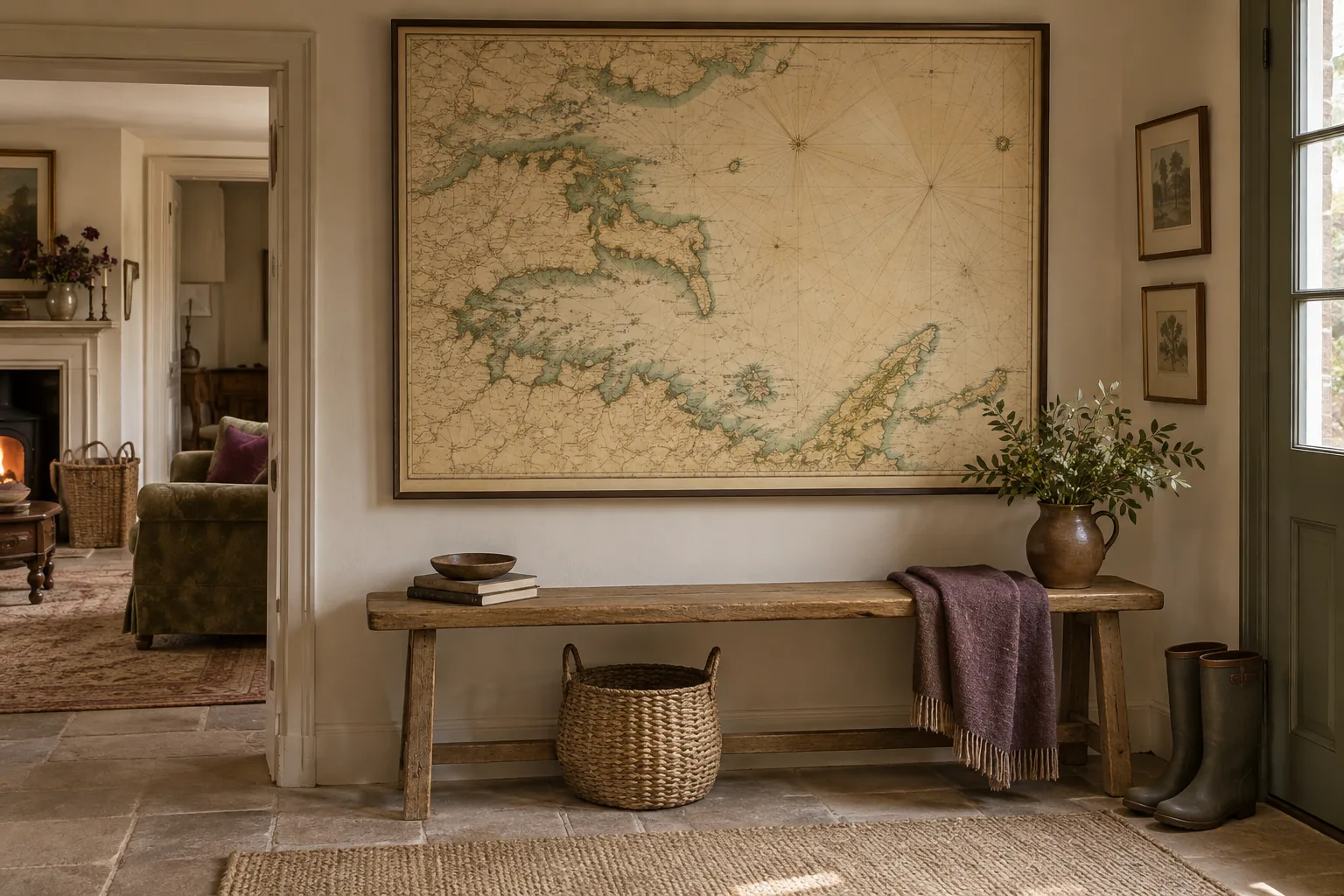
A detailed map above a deep sofa may never be read comfortably. If the tiny street names are the attraction, place it where you can approach without climbing over furniture. If its broad outlines are what you like, a more distant position can work well. Try a paper template at the intended height.
Check the dimensions of the complete sheet, not only the image. A frame and mount will enlarge the final object. Leave room for those additions before buying, and ask a framer for an estimate if the format is unusually wide or tall. An inexpensive map may need a substantial custom frame to be displayed properly.
Respect folds and fragile paper
Folds can be part of a map's history, but they may also be weak points. Ask about tears, repairs, staining and material attached to the back. Do not buy on the assumption that ironing or pressing at home will solve everything. A paper conservator can assess significant or fragile material.
The Library of Congress offers care guidance for paper collections and display. Appropriate mounting, storage materials and a considered location matter more than giving the sheet an artificially aged frame. Avoid trimming margins merely to fit a ready-made frame; those areas may contain information you later wish you had kept. Let the presentation adapt to the map rather than the reverse.
Let it start a conversation quietly
A map does not need a large wall label explaining its significance. You might keep a short note on the reverse of the frame, separate from the sheet, recording the seller's description and your connection to the place. Retain photographs and documentation in a digital folder as well.
Surround the map with objects that leave its detail visible. A plain lamp or low bowl is often enough nearby. You can enjoy tracing a familiar route while acknowledging that the sheet is a historical representation with its own omissions and perspective. That attentive relationship is more rewarding than treating every old map as interchangeable beige decoration.