Think about opening it
A small box promises order: somewhere for a few loose objects, an attractive lid to close on the mess. Yet many old boxes are best treated as display pieces. Begin by deciding whether you want something to open every day or something to admire. That distinction affects how much wear, fragility and uncertainty you can comfortably accept.
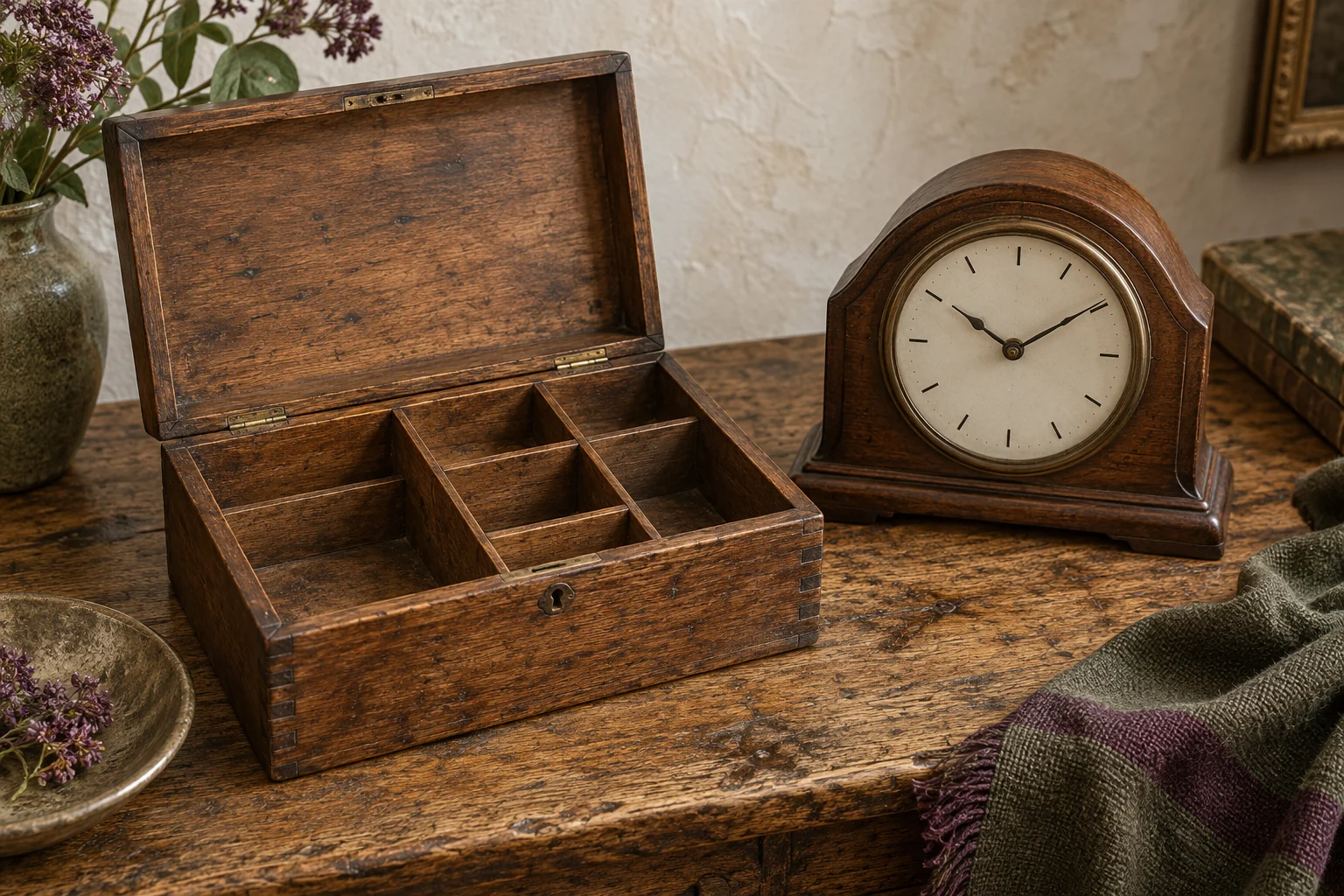
Open and close the lid gently with the seller's permission. It should not need forcing. A hinge that strains, a lid that catches or a loose internal tray deserves attention before purchase. Do not assume a repair will be simple because the object is small. Fiddly fittings can require more care than their scale suggests.
Look inside without romanticising it
The interior may reveal stains, odours, worn linings or missing compartments that are absent from the listing's hero photograph. Ask for a clear view in ordinary light. A faded velvet lining can be visually appealing without being suitable for storing jewellery or delicate paper. Unknown residues should not become part of daily use by default.
Avoid planning to remove a lining or sand the inside before you have considered what would be lost. Original components can hold useful information even when they look tired. If the box matters historically or financially, ask a conservator before altering it. For an inexpensive everyday storage need, a sound newer box may simply be the more practical purchase.
Check how much it actually holds
External dimensions can be misleading. Thick walls, a shallow lid and internal divisions may leave little useful space. Measure the object you hope to store and ask for usable internal measurements if buying remotely. A box that fits a watch may not fit its strap laid flat.
It can help to assign one modest purpose rather than imagining the box will solve every small-storage problem. Perhaps it will hold modern spare buttons in a separate suitable container, or sit empty on a desk. Keep sensitive keepsakes in storage appropriate to their materials rather than assuming an old decorative box provides protection merely because it has a lid.
Place it where the top is visible
A low box can vanish on a deep shelf, particularly if its main decoration is on the lid. A side table viewed from above might show it much better. Check the sightline from a chair and from the doorway. An object should not need to be picked up constantly for its best feature to be appreciated.
Avoid stacking several delicate boxes to manufacture height. The bottom lid then becomes a support it may never have been designed to provide. If you decide to stack robust boxes, consider access and stability first. Often one carefully placed box beside a taller plain object makes a clearer arrangement than a complicated tower.
Keep the description factual
Words such as jewellery box, sewing box or keepsake box sometimes describe a seller's suggested use rather than a documented original function. Ask what evidence supports the label. An unexplained compartment can remain unexplained; you do not need to supply an elaborate story to enjoy the object.
Photograph the interior, hinges, base and any marks when it arrives. Record repairs and missing parts so you do not forget which features were already present. A box can become personal through what it means in your home, but that present-day meaning should remain separate from claims about who made it or what an unknown previous owner kept inside.