Start before the parts become a mystery
A drawer key is put in a safe place, a handle comes off during a move, or a conservator returns an original component that has been replaced. Each event seems small. Years later, the household has a bag of interesting metal pieces and no reliable idea which object they belong to. The easiest time to prevent that is when the part first becomes separate.
Give the parent object a simple reference and record the component's relationship to it. A photograph of the fitting in place, when available, is particularly useful. If it was found loose rather than deliberately removed, note that distinction. Do not turn a plausible association into certainty merely because the part looks as though it should fit.
Keep description and location together
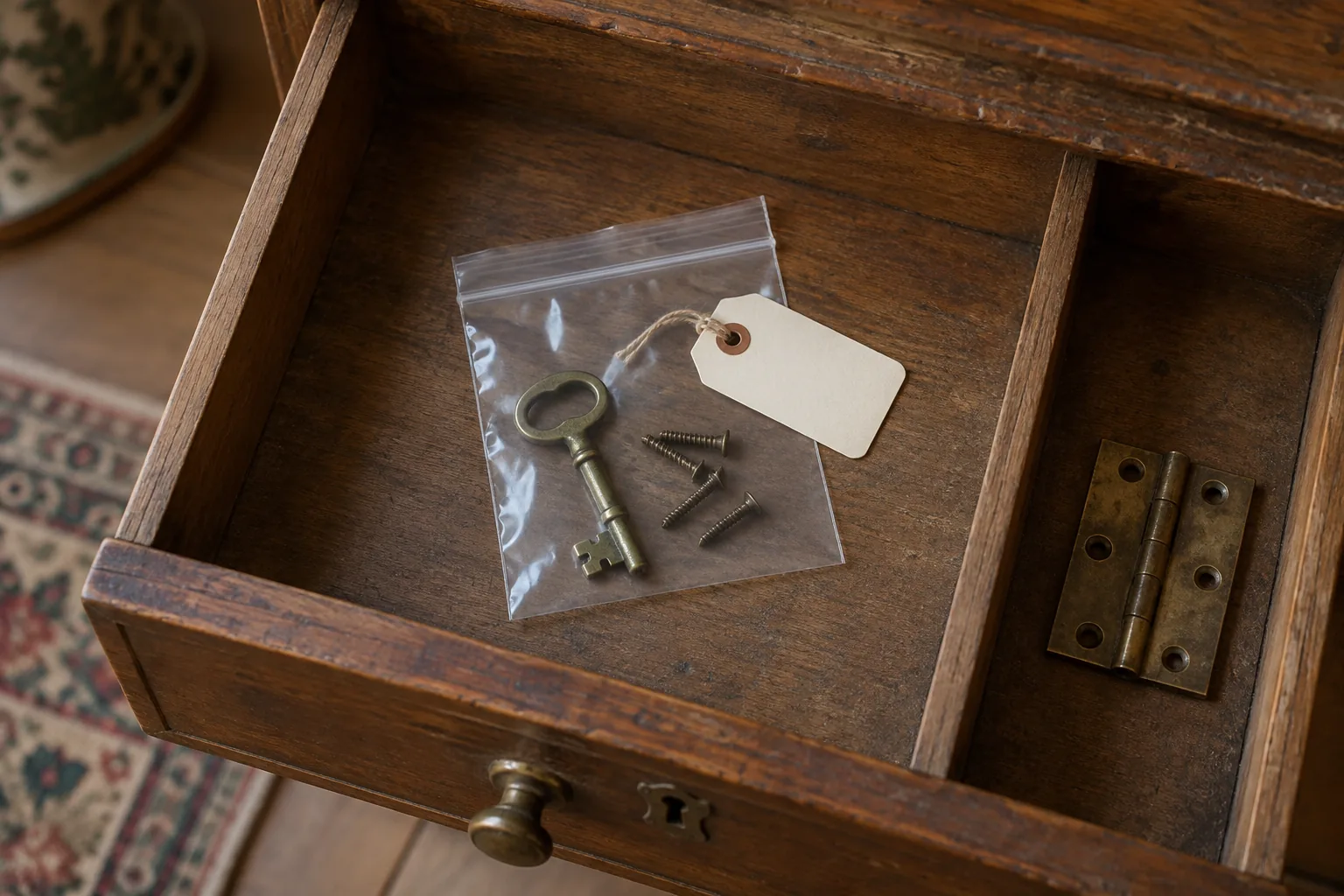
Write down what the part appears to be, its approximate dimensions and where it was found or removed. Include the date and the person who handled the work. A note saying left cupboard hinge from hall cabinet is much more useful than old hinge. Avoid attaching labels directly to original surfaces without appropriate advice.
The Canadian Conservation Institute discusses dissociation as the loss of connections between objects and their information. A household fitting is a small but clear example. Preserving the component without its context can leave a future owner unable to use or interpret it correctly.
Use one system you can maintain. A numbered photograph and a short inventory entry may be enough. There is little benefit in an elaborate database if the parts continue to be dropped into an unlabelled kitchen drawer while you wait for time to update it.
Choose protection for the material
Ask a conservator or suitable conservation supplier about packaging if the component is fragile, corroding, coated or made from unfamiliar materials. A soft-looking wrap or airtight container is not automatically appropriate. The aim is to prevent loss and damaging contact without creating another condition problem.
Keep related parts together in the records, but do not force them into one physical bundle if their condition calls for separate protection. Small screws should not rub against a delicate finished handle merely because they belong to the same assembly. Record which container holds each component.
Do not polish or clean a removed fitting simply to make storage neater. Residue, wear or surface layers may be relevant to its history and future assessment. If there is active deterioration, seek advice rather than covering it with a product and putting it away.
Avoid a trial-and-error reunion
When the furniture needs work, provide the component and its record to the professional involved. Do not force a key into several locks or try a screw in multiple holes to discover where it belongs. Similar-looking fittings can differ in ways that matter to the object.
If a part has been replaced, retain the treatment documentation explaining why. A future owner may otherwise assume the loose original should be reinstalled. The useful record includes the decision, not only the component's identity. Ask the practitioner whether anything else should accompany it.
Make the information travel
Store the parts in a known location and include that location in the furniture's records. If the object is sold, given away or inherited, transfer the associated fittings and documentation with it. A note hidden in an unrelated box is unlikely to make that journey by accident.
Review the arrangement after a move or a major clear-out. These are the moments when small labelled packages can become separated from the paperwork that explains them. Photograph the storage container if that helps others recognise it.
The result need not look like a museum store. It simply needs to answer three questions: what is this, what does it belong to and why is it separate? Those answers can save a later repair from guesswork and preserve a small part of the object's history that would otherwise disappear in the most ordinary way.