Take everything off one shelf
It is difficult to judge a crowded shelf while every object remains in its familiar place. Clear one level completely, placing the contents somewhere safe, and look at the empty shape. Notice its width, height and relationship to the shelves above and below. This is the frame within which the objects will sit.
Choose the piece you most want to see and return that first. It may be a bowl, a framed image or a group of books. Giving it priority makes the next decisions easier. You are no longer trying to find a place for every object simultaneously; you are building an arrangement around something that matters.
Make groups with visible edges
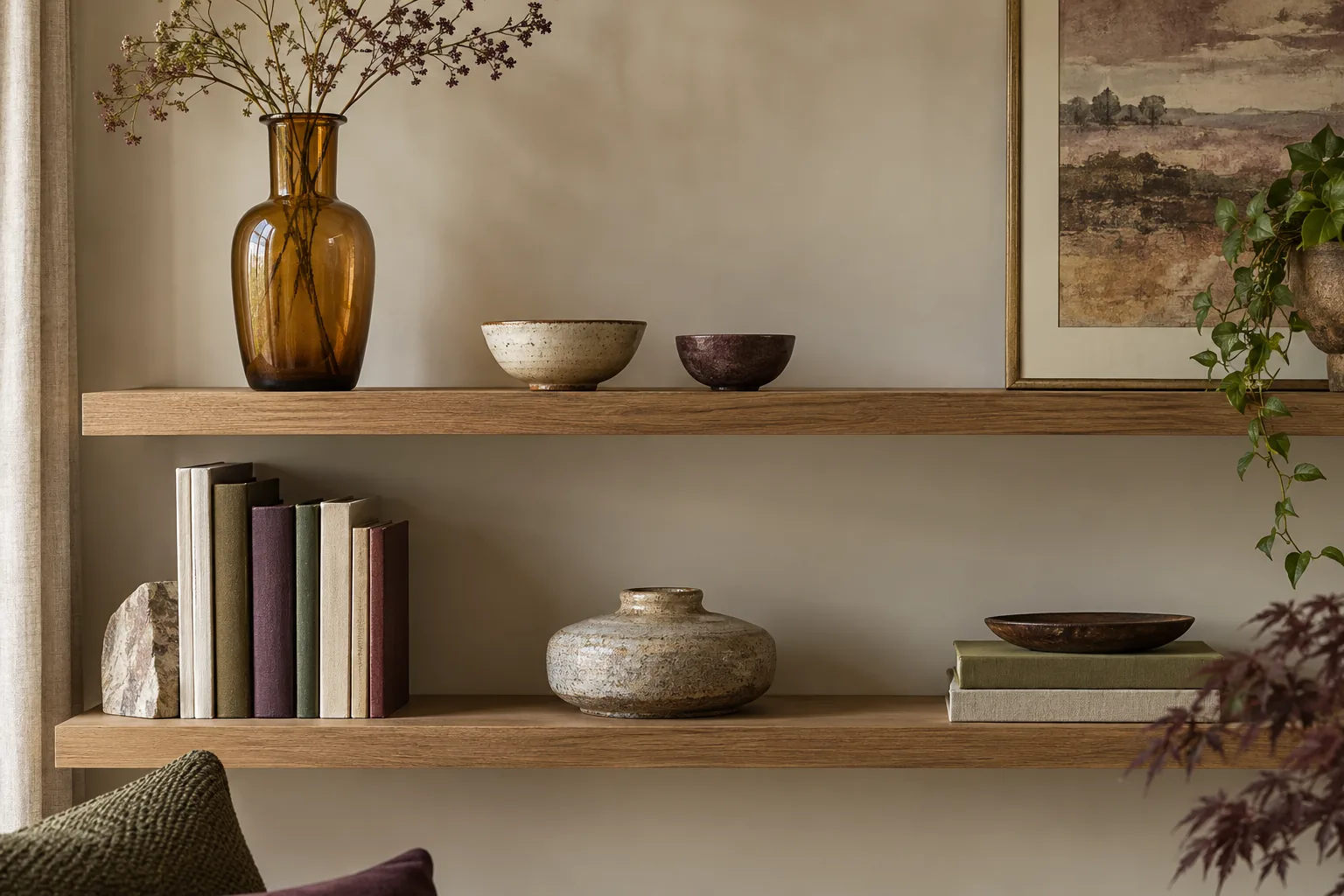
Objects placed close together tend to read as one group. Use that effect to simplify the shelf: a small stack of books with a low object beside it can form a single area of interest. Leave a clear gap before beginning the next group. The space helps the eye understand where one arrangement ends and another begins.
Avoid spreading objects at equal intervals merely to occupy the whole width. This can make the shelf look like a row of items awaiting inspection. A larger gap on one side may feel more natural, especially when balanced by the contents of neighbouring shelves or by a stronger shape elsewhere in the unit.
Change the height without making a skyline
A little variation in height creates rhythm, but a shelf full of alternating tall and short objects can become fussy. Try one dominant height with lower forms around it. Consider the empty area above the objects as part of the composition rather than wasted storage space.
Keep placement practical and safe. Heavy belongings need suitable support, and fragile pieces should not be balanced on unstable stacks. If books are frequently used, they must remain easy to remove without disturbing a display. Decorative arrangements that interfere with ordinary access usually become untidy quickly because people have to undo them to reach what they need.
Let neighbouring shelves do different jobs
A bookcase does not need every level to contain the same mixture of books, ceramics and pictures. One shelf can be mostly books while another holds a larger object with more space around it. This variation often looks calmer than repeating a complete miniature display on each level.
Step back to view the unit as a whole. Dark objects, dense book runs and large frames create visual weight, so distribute them with some care. You do not need a perfectly symmetrical pattern. Look for an arrangement that feels settled across the full height, with quieter sections giving the more detailed groups room to be appreciated.
Keep the removed objects in circulation
Editing a shelf does not require deciding that everything removed is unwanted. Store a few pieces safely and exchange them when you feel like a change. A smaller rotating display can make familiar objects more noticeable than a permanent arrangement containing the entire collection.
Before putting anything else back, live with the edited shelf for several days. An initially unfamiliar gap may become the part that makes the whole composition work. Add an object only if it improves a specific relationship, not because the space makes you feel that something is missing. A shelf can be full of meaning while leaving plenty of its surface visible.