Admire the construction first
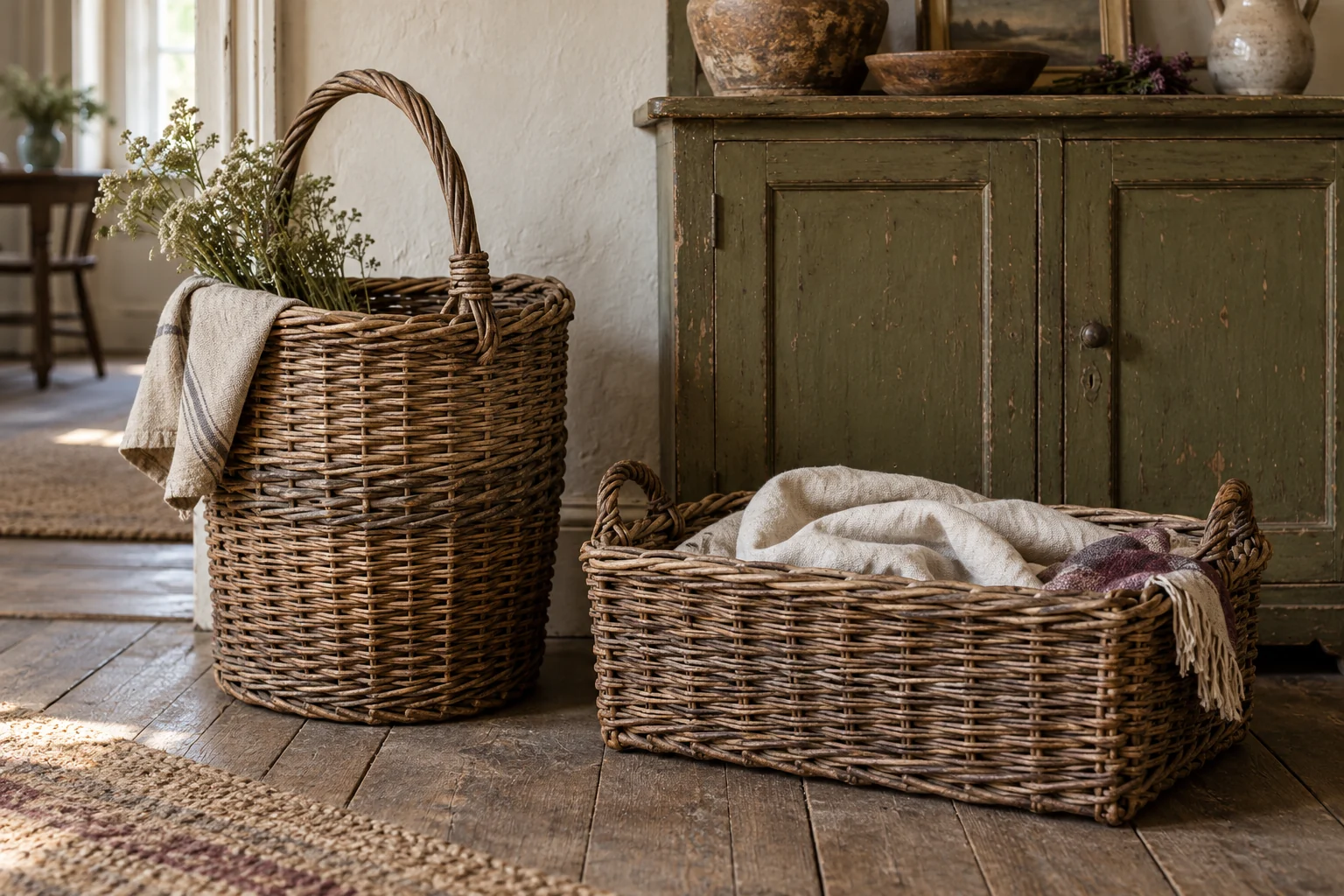
A basket can make a room feel less rigid. Its woven surface interrupts polished wood and flat painted walls, while the rim often has a wonderfully irregular line. Start by looking at those qualities before deciding what it should hold. An old basket may deserve an empty decorative role rather than another working life full of magazines or logs.
Turn your attention to the base, rim and points where the handle joins the body. These are useful places to inspect for breaks, distortion and previous repairs. Ask for photographs of the underside if buying online. A picture filled with throws can be attractive while showing almost nothing about the basket's actual condition.
Do not confuse age with strength
Plant materials can become fragile, and a basket's original function does not establish its present capacity. The Canadian Conservation Institute discusses how physical damage, environmental conditions and pests affect basketry. Handle an uncertain example with support beneath the body rather than treating a convenient handle as proof that it can carry weight.
Avoid testing strength by flexing the weave or tugging at loose strands. Ask the seller to describe weak areas and consider whether you can accommodate them. A basket that needs specialist care is not necessarily a poor object, but it may be a poor choice for the busy hallway where shoes are dropped several times a day.
Match the scale to the room
A large basket can occupy a corner beautifully, but measure its broadest point and the full height of the handle. Handles are often the part that collides with a table edge or obstructs a door. A small, shallow basket may be easier to enjoy on an open shelf, where its interior is visible.
Compare the weave with neighbouring textures. Fine basketry beside a heavily patterned rug may disappear; a broad weave against a plain wall will be clearer. You do not need to repeat wicker furniture elsewhere to justify one basket. Its contribution can be a single organic surface in an otherwise orderly arrangement.
Keep the contents optional
If the basket is sound and suitable for a light practical use, think about what will touch it. Sharp corners, damp items and frequent overfilling can be unkind to an old weave. Sensitive papers or textiles may also require their own appropriate storage rather than direct contact with an unknown material.
An empty basket is not a styling failure. It lets you see the construction and avoids concealing damage. A delicate example can sit on a stable shelf with enough clearance around it, while a sturdy modern basket performs household storage duties nearby. You are choosing an object for the qualities it has now, not insisting that it repeat its original workload.
Be cautious with stories and treatments
Ask for reliable information before accepting a regional or cultural attribution. Similar-looking forms can have different origins, and generic labels should not replace knowledge of a maker or community. Preserve any documented history with the object and keep uncertain seller descriptions explicitly uncertain.
Avoid soaking, oiling or spraying an old basket in an attempt to restore flexibility or freshness. Care depends on the materials and condition, and a conservator can advise on a significant piece. If you dislike the basket as it stands, pass it by. Buying a sound form and appealing weave is a better beginning than hoping an improvised treatment will create the object you wanted.